


Volcanic Rupture Nodes Part 2: Solar Entanglement
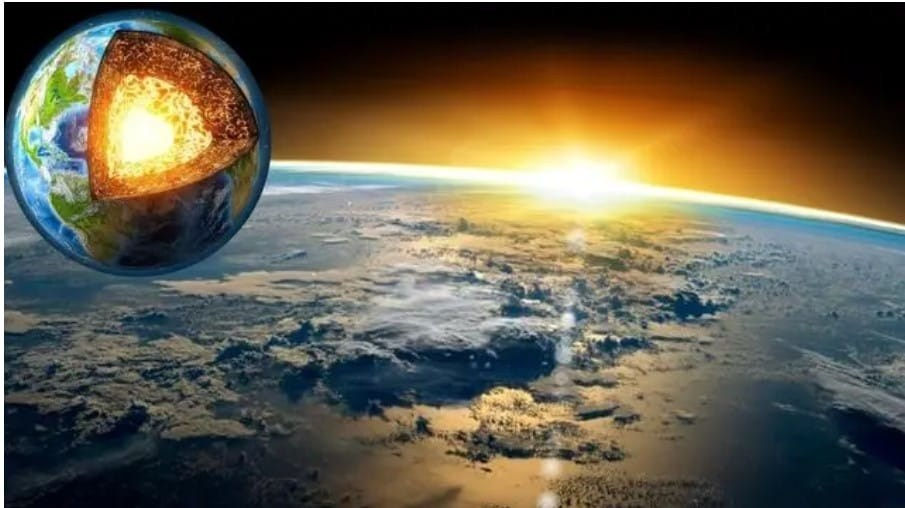
For anyone following the volcano post, here’s a follow-up with a bit more physics language for clarity:
When one body orbits another (like Earth around the Sun), the connection between them isn’t just distance in space. Their shared motion creates a wave function that centers on the line between their cores—a kind of tension axis that the system “locks” onto.
You could call that axis an entanglement line, like the way physicists talk about two objects being linked beyond normal space via wormholes. This sounds crazy but is correct: there is a hidden core-to-core channel between what we experience on earth and solar activity. Information or influence moves differently than it does across the surface. Our gravitational field is "down," but when it hits the core it becomes "towards the sun."
So here’s the point: we live on the surface layer, but the real connection between Earth and Sun runs straight through the interior, and rupture points (volcanic bands, life-origin nodes like Galápagos) are where that deeper axis breaks through our plane of experience.
That’s why I’m treating those spots as more than geological accidents — they’re contact points between a hidden core-link and the surface dimension life emerges on.
The calculated reset point of the entire cosmic time cycle — derived from the full sequence of precessional and axial alignments — lands exactly on a single volcanic vent, with no margin of error. It’s not near it; it is on it. That vent is an active rupture in Earth’s crust, the same site where Darwin documented accelerated speciation. The match is 100 percent precise. The volcano marks the spot where the entanglement axis punctures the physical plane — the literal intersection of temporal recurrence and geological creation.
And when you trace the alignments further back through time, an uncertainty interval emerges — and within that narrow band, every other major volcanic rupture clusters exactly where the model predicts. It’s a recurring, stable interference pattern that mirrors wave dynamics, the same way the double-slit experiment reveals probability distributions.
At that puncture point, time itself doesn’t flow smoothly — it diffracts. Moments overlap and recombine, folding the physical and the temporal layers into one geometry.


Comments