


Reading the Deep Past at Low Resolution
Most controversies about the deep past persist because modern inquiry treats history as fully collapsed and classical, even when the evidence itself behaves more like a wave than a particle. In physics, when systems are separated from us by distance, they are not treated as fully resolved objects but as probability distributions constrained by limited interaction. Wave–particle duality, superposition, and interference are not exotic claims; they are standard tools for handling incomplete access. Crucially, physics makes no distinction between distance in space and distance in time. Both are spacetime intervals. What changes is not the law, but the degree of constraint imposed by observation.
The deep past sits under the same conditions. It is not governed by different physics, but it is accessed indirectly, through partial traces that cannot force a single, fully collapsed description. As a result, multiple coherent interpretations can remain compatible with the surviving data without contradiction, not merely as metaphors but as structurally consistent timelines that behave like true histories until one is preferentially constrained by evidence. This does not require asserting that only one past ever existed; it reflects how collapse functions at the level of description rather than ontology.
Once this is acknowledged, a number of long-standing puzzles stop competing and begin to resonate.
Ancient texts consistently describe earlier orders of beings as larger, more capable, and ultimately incompatible with the later human world. In Genesis, the Nephilim are paired with “men of renown,” a phrase that already admits multiple readings: lineage, status, memory of exceptional individuals, or something more structural. They are not overthrown but removed, their continuation rendered unsustainable. This pattern repeats across traditions. The emphasis is not conquest, but entropy: decline through inheritance, dilution, or changing conditions. The same archetype appears whether one reads the passage sociologically, symbolically, or biologically.
That biological layer is difficult to ignore.
Dinosaurs are not speculative; they are certain. What is uncertain is everything that did not fossilize. Bones preserve rigidity while erasing precisely those systems that govern lift, respiration, membranes, feathers, and motion. Reconstructions therefore privilege weight and constraint. Under present-day assumptions about gravity and planetary stabilization, size becomes paradoxical. Models such as Neil Adams’ growing-Earth visualization matter here not because they must be accepted wholesale, but because they expose an assumption that quietly governs interpretation: that Earth’s radius and stabilization were always fixed. If planetary growth and stabilization occurred over time, organisms that appear biomechanically implausible under current constraints no longer do. To the organisms themselves, nothing unusual is happening; the difference lies in the observer’s frame.
This is where myth enters as a legitimate carrier of information rather than a failure of explanation. Dragons recur globally not as random fantasy, but as a stable synthesis: serpentine form, aerial capability, dominance, and danger. A dragon does not need to be “literally present in human times” to encode the memory of a reptilian world with wings. Forgetting details while preserving structure is exactly how symbolic systems behave after rupture.
The same compression occurs at the human scale after the Younger Dryas. Whatever mechanisms one accepts for that transition, the outcome is clear: rapid environmental change, flooding, megafaunal loss, and cultural fragmentation. What survives is not technical continuity but symbol: floods, lost lands, scattered peoples, broken lineages. This diaspora is unusually well supported by convergences in myth, language families, monumental architecture, calendrical astronomy, and shared symbolic motifs appearing independently across continents, including repeated stories of linguistic fracture that resemble the Tower of Babel pattern more than a localized legend.
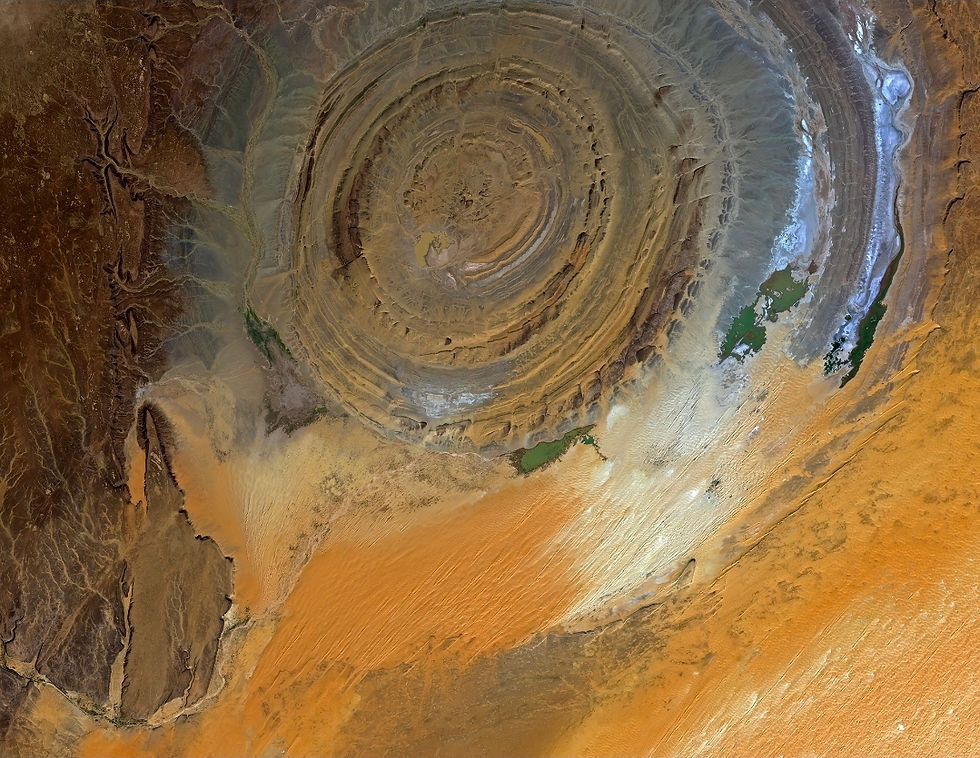
Atlantis fits cleanly here. It functions as a memory-object of collapse, not a divine fairy tale. Geological structures such as the Richat Formation are compelling because they preserve scale, geometry, and collapse patterns consistent with the narrative residue, including its placement beyond the Pillars of Hercules, its concentric morphology, and flood-erosion signatures that align with water movement along former shorelines toward North Africa and Egypt under post-glacial inundation models. These features do not prove identity, but they render the correspondence unusually tight.
Feathered serpents sharpen the picture further. They sit at the intersection of layers: aerial reptiles, cometary imagery, authority, and catastrophe. One symbol carries multiple meanings without contradiction. Dragons, dinosaurs, comets, and civilizational resets are not rival explanations; they are different projections of the same interference pattern.
Even extraterrestrial interpretations belong here. They are neither mandatory nor dismissible. They represent another coherent reading through incomplete information, one that persists precisely because the signal has not collapsed into a single account. The error is not believing one layer, but insisting that one layer must cancel all others.
The deep past does not demand belief in a single, fully resolved history. It demands recognition that meaning survives collapse the way waves survive interference: patterns repeat, structures echo, details fade. When history is treated with the same interpretive discipline already granted elsewhere in physics, giants, men of renown, dragons, dinosaurs, Atlantis, and diaspora stop contradicting one another. They describe the same underlying past at different resolutions.



Comments